


.png?width=580&height=249&name=DFX%20graphics%20(613%20x%20263%20px).png)
A medical device lighting concept can look promising in early development. It may meet the optical requirements, fit the intended use case, and demonstrate strong potential in a prototype. But getting from concept to commercial production requires more than proving the idea works.
The design also needs to be manufacturable, repeatable, scalable, and ready for the realities of production.
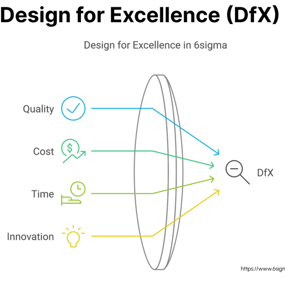
That is where Design for Excellence, often called DFX, becomes an important part of the development process. DFX is an engineering approach that looks beyond whether a product performs as intended. It considers the full product lifecycle early in design, including manufacturability, assembly, quality, reliability, testability, serviceability, sustainability, and long-term production support.
For medical device companies, this mindset can help reduce risk before costly design changes are required.
“A product that works is only part of the equation,” said Joe Dombrowski, Vice President of Engineering at Lumitex. “The real question is whether it can be built consistently, efficiently, and at the quality level medical devices require.”
Why DFM and DFA matter
Within the broader DFX framework, two disciplines are especially important for product development: Design for Manufacturing and Design for Assembly.
Design for Manufacturing, or DFM, focuses on whether individual components can be made reliably, consistently, and cost-effectively. This includes decisions around material selection, geometry, tolerances, and the specific manufacturing process used to make the component.
Design for Assembly, or DFA, focuses on whether those components can be put together efficiently and correctly. It considers part count, assembly steps, fasteners, alignment features, mistake-proofing, and the overall ease of building the finished product.
In simple terms, DFM makes parts easier to make. DFA makes products easier to build.
For medical lighting, both are critical. Lighting solutions often need to fit within tight spaces, manage heat, maintain optical performance, integrate with other device components, and support the usability needs of clinicians and patients. If manufacturability and assembly are considered too late, teams may encounter unexpected cost, delays, supplier challenges, quality issues, or redesign work.
“When we think about manufacturability early, we are not limiting innovation,” Joe said. “We are giving that innovation a better chance of becoming something that can actually scale.”
The cost of waiting too long
Many manufacturing challenges are created by decisions made early in the design process. A tolerance that is tighter than necessary, a material that is difficult to source, a component that is hard to inspect, or an assembly that requires too many manual steps can all create downstream issues.
Those challenges are usually easier and less expensive to address before a design is released.
Good DFM and DFA practices can help reduce manufacturing costs, shorten assembly time, improve quality, increase yield, and support higher production volumes. They can also make products easier to validate, easier to inspect, and easier to support over time.
One of the most powerful DFM principles is simplification. Every part, fastener, and assembly step adds cost and creates another opportunity for variation or error. Reducing unnecessary complexity can have a meaningful impact on production efficiency and product reliability.
Standardization is another important principle. Using common materials, proven components, standard hardware, and established manufacturing methods can help reduce supply chain complexity and improve consistency.
The goal is not to make the design as simple as possible at the expense of performance. The goal is to create a design that meets the product requirements while also supporting reliable production.
Designing around the right manufacturing process
Every manufacturing process has its own design rules. A component designed for injection molding has different requirements than one designed for CNC machining, sheet metal fabrication, additive manufacturing, or electronics manufacturing.
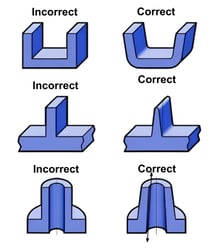
For example, injection molded parts benefit from uniform wall thickness, proper draft angles, and thoughtful rib and boss design. Machined parts should avoid unnecessary complexity, deep narrow pockets, and excessive tool changes. Electronics manufacturing requires attention to PCB layout, component spacing, and thermal management.
The manufacturing method should not be an afterthought. It should influence the design from the beginning.
For Lumitex, this is especially important because medical lighting solutions often involve a combination of optical, mechanical, electrical, material, and manufacturing considerations. The best outcome comes when these disciplines are considered together instead of in isolation.
The added complexity of medical devices
Medical device development adds another layer of responsibility. A design cannot simply be easy to manufacture. It also needs to support safety, performance, regulatory expectations, quality requirements, and long-term reliability.
Material selection may need to account for biocompatibility, sterilization compatibility, packaging, durability, and environmental conditions. Designs may need to align with FDA requirements, ISO 13485 quality systems, design controls, traceability, risk management, verification, validation, and supplier qualification.
“A prototype built by an expert in a development setting is not the same thing as a repeatable manufacturing process,” said Craig Shields, Chief Operating Officer at Lumitex. “DFX helps close that gap by forcing the right questions earlier.”
That gap between prototype and production is one of the biggest challenges in medical device development. A prototype may be assembled by someone who understands every detail of the design. But commercial production requires a process that can be repeated consistently, inspected effectively, and scaled without sacrificing quality.
DFX helps teams identify those risks while there is still time to make practical design decisions.
A cross-functional approach
DFX is not just an engineering checklist. It is a collaborative way of working.
The strongest product development processes bring engineering, manufacturing, quality, supply chain, regulatory, suppliers, and contract manufacturers into the conversation early. This allows teams to identify potential issues before major design decisions are locked in.
Early manufacturing involvement can include prototype manufacturability reviews, supplier feedback, pilot builds, process capability assessments, and design verification planning. These activities help teams understand whether a product can move from a promising design to a repeatable production process.
“DFX is not something you add at the end of development,” Craig said. “It has to be part of the culture, from early design reviews through production launch and continuous improvement.”
That continuous improvement mindset matters. DFX does not stop once a design is released. Production performance, scrap rates, yield, cycle time, cost, and quality data can all provide valuable lessons for future designs.
.png?width=323&height=245&name=DFX%20graphics%20(415%20x%20315%20px).png)
Building better medical lighting solutions
For medical device teams, the most successful lighting solutions are not just innovative. They are practical, reliable, manufacturable, and scalable.
By bringing manufacturability and assembly considerations into the process earlier, teams can reduce development risk and improve the path from concept to commercialization.
At Lumitex, this means looking at lighting design through a broader lens. Optical performance matters, but so do materials, tolerances, assembly methods, inspection access, supplier capabilities, production flow, and long-term scalability.
The result is a lighting solution that is designed not only to work, but to be built consistently, safely, and efficiently.
“The easiest and least expensive time to solve a manufacturing challenge is before the design is released,” Joe said. “That is the value of bringing DFX thinking into the process early.”
For medical device companies working to bring new technologies to market, that early thinking can make all the difference.
.jpg)

Comments