

Mitovation and Lumitex Collaborate to Develop an Infrared Light System
Reperfusion injury following cardiac arrest remains a major challenge in critical care medicine. When blood flow returns to the brain after a period of oxygen deprivation, the sudden reintroduction of oxygen can trigger mitochondrial hyperactivity and the release of damaging reactive oxygen species (ROS), contributing to neurological injury and long-term disability (Pham et al., 2025; Biochemical Society Transactions, 2022).
Mitovation, a medical device startup based in Ann Arbor, Michigan, is developing a novel, non-invasive therapy that uses precisely controlled infrared light to modulate mitochondrial activity during this critical window. Founded by researchers studying mitochondrial physiology and infrared light interactions, the company aims to inhibit mitochondrial overactivity and protect neural tissue following ischemic events.
To translate this scientific insight into a clinical device, Mitovation partnered with Lumitex, leveraging expertise in optical engineering, medical device light therapy, and integrated system design.
The Challenge
Mitovation’s research demonstrated that specific wavelengths of near-infrared light can inhibit cytochrome c oxidase activity during early reperfusion, reducing the burst of ROS that contributes to neuronal damage (Pham et al., 2025).
Translating this biological mechanism into a usable clinical therapy, however, presented several complex engineering challenges:
• Delivering therapeutic wavelengths safely through the scalp and skull
• Achieving uniform light distribution across targeted brain regions
• Integrating lasers, optics, electronics, and software into a cohesive system
• Designing for ease of use in ICU environments
• Meeting requirements for clinical trials and regulatory pathways
“We had the biological insight and the therapeutic vision,” said Tom Waddell, Chief Operating Officer at Mitovation. “But building a device that could actually deliver that therapy required expertise in optical and system engineering.”
The Solution
Mitovation engaged Lumitex early in the development process to help transform the concept into a manufacturable medical device.
Working collaboratively, the teams defined system requirements, identified technical risks, and developed feasibility prototypes. This early phase enabled rapid iteration, allowing both teams to refine requirements and validate performance before advancing into full development.
“From an engineering perspective, the real challenge was taking a very specific biological mechanism and turning it into a controlled optical therapy,” said Joe Dombrowski, VP of Engineering at Lumitex. “That meant dialing in the right wavelengths, designing the optical path, and making sure the system could consistently deliver in a clinical setting.”
Lumitex engineers supported:
• System architecture and design inputs
• Risk identification and mitigation
• Optical delivery design
• Integration of lasers, fiber optics, electronics, and controls
“Light is a challenging medium to work with,” Waddell added. “You’re dealing with optics, electronics, mechanics, and software all at the same time. Lumitex has the experience needed to develop new Photobiomodulation systems.”
The Device
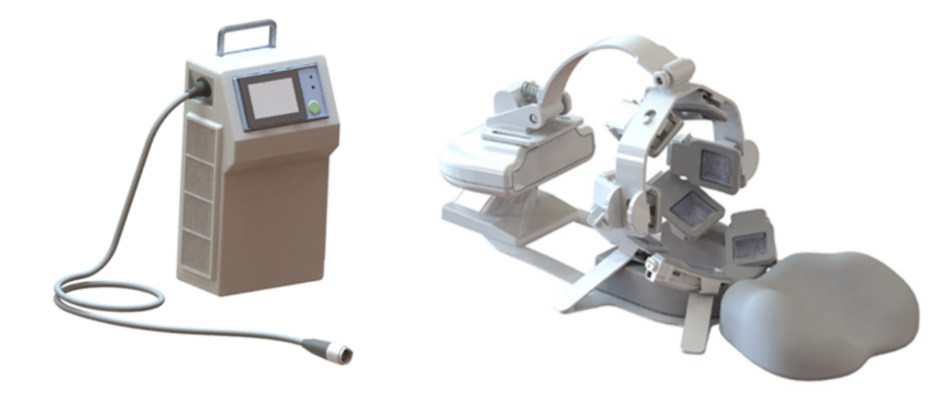
The resulting system delivers controlled infrared light therapy to the patient’s scalp following cardiac arrest.
It consists of two primary components:
• Light Control Unit (LCU): Generates infrared wavelengths and controls system operation
• Patient Cap: Uses integrated optical waveguides to distribute light across the scalp
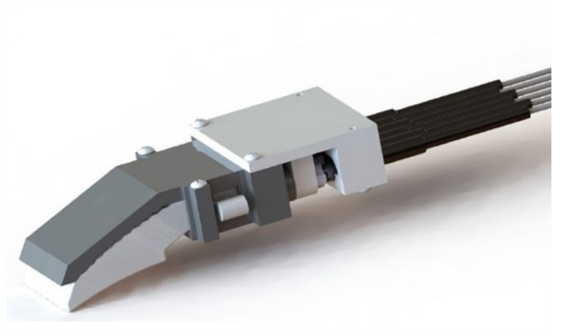
Figure shows CAD diagram of a near-infrared light delivery waveguide (Morse et al., 2023)
The system delivers approximately 4 watts of infrared light at wavelengths around 750 nm and 940 nm. Light is transmitted through fiber optics to multiple delivery points within the cap, enabling consistent coverage of targeted regions.
“Delivering therapeutic light to the brain requires careful engineering,” Dombrowski said. “You have to account for tissue attenuation, ensure uniform distribution, and build in monitoring to confirm the therapeutic dose is delivered safely and consistently.”
Embedded sensors confirm proper contact and monitor system performance throughout treatment.
Therapy is typically administered for approximately two hours following the return of spontaneous circulation, targeting the critical early reperfusion window when mitochondrial dysfunction is most damaging.
Designing for Flexibility
Recognizing that mitochondrial modulation may have broader applications, the system was designed with additional optical capacity.
While initial clinical studies focus on neonatal and pediatric cardiac arrest, the platform may be adapted for other neurological conditions, including:
• Spinal cord injury
• Traumatic brain injury
• Ischemic stroke
• Neonatal hypoxia-ischemia
Preclinical studies have demonstrated improved neurological outcomes and reduced brain injury when infrared light therapy is applied during reperfusion.
Conclusion
Advancing new medical therapies requires close collaboration between scientific innovators and engineering partners.
By combining Mitovation’s research in mitochondrial physiology with Lumitex’s expertise in optical system design, the partnership has produced a novel therapeutic platform aimed at reducing brain injury after cardiac arrest.
“We’ve had a great experience working with Lumitex,” Waddell said. “They are responsive and knowledgeable in developing light-based medical systems.”
As the device progresses through clinical development, the collaboration highlights how early engineering partnership can accelerate the translation of scientific discovery into real-world medical technology.
Note: This technology is currently focused on confirming previous findings through ongoing research support, designing a human interface for its medical device, and preparing for first-in-human clinical trials in pursuit of FDA approval. This technology has not yet received FDA approval.
Sources
FAQ Section
What is the Infrared Light System?
The Infrared Light System is a medical device developed by Mitovation that delivers controlled infrared photobiomodulation therapy to reduce brain injury following cardiac arrest. It targets the critical early reperfusion window when mitochondria are most susceptible to overactivity and oxidative damage.
Who engineered the optical system for the device?
Lumitex partnered with Mitovation to design and develop the optical delivery system, integrate lasers, and build the overall engineering architecture. Lumitex is a U.S.-based engineering and manufacturing company specializing in custom lighting systems and photobiomodulation devices for medical technology applications.
What wavelengths does the therapy use?
The system delivers infrared light at approximately 750 nm and 940 nm, selected to modulate mitochondrial activity and reduce reactive oxygen species during reperfusion.
What medical conditions is the device designed to treat?
The primary indication is to reduce reperfusion injury and neurological damage after cardiac arrest. The system may also have future applications for other neurological conditions, including traumatic brain injury, ischemic stroke, spinal cord injury, and neonatal hypoxia-ischemia.
How is the therapy delivered to the patient?
Therapy is delivered through a patient-specific cap containing optical waveguides that distribute light across the scalp. Embedded sensors ensure proper contact and monitor system performance throughout treatment.
How long does a typical treatment session last?
A standard session lasts approximately two hours following return of spontaneous circulation, focusing on the critical early reperfusion window when mitochondrial dysfunction is most damaging.
Is the system safe for clinical use?
Yes. The device integrates monitoring systems to ensure consistent light delivery, maintains safe power levels, and is designed to meet regulatory and clinical trial requirements. Clinical studies are ongoing to validate safety and efficacy.
Can the device be used in different patient populations?
While initial studies focus on neonatal and pediatric patients after cardiac arrest, the system’s design allows potential adaptation for adult patients and other neurological conditions in future clinical research.
Why was Lumitex chosen as the engineering partner?
Lumitex brings specialized expertise in optical engineering, system integration, and photobiomodulation device development. Their collaboration ensured that the scientific therapy could be translated into a safe, reliable, and manufacturable medical device.
We work with you throughout the entire product development process to create innovative lighting system solutions